I try to avoid political posts, but when I found this article on foxnews.com, I had to write about it.
The article basically says that most economists agreed that Obama's economic policies would help the economy. Unemployment rose to 10% under the policies, but I've heard supporters of those policies say that otherwise, employment would be at 12%. Republicans, meanwhile, knew that opposing the policies would slow down economic recovery. They knew that a slower recovery would make Democrats look bad and give Republicans a better chance in the midterm elections. On Tuesday, the Republicans' strategy worked. And this is all according to the Fox News article.
It's hard to believe that a political group could take a stance essentially aimed at hurting the country and benefit because of that stance. I'm sure Democrats have done it in the past, but the freshness of this occurrence makes it seem that much more audacious, as the article calls it, probably in reference to one of Obama's favorite words. Personally, I would prefer "dastardly" because it almost rhymes with the word that I actually want to use but prefer not to.
I also think it's interesting that the Fox News article states outright that the Republicans tried to keep the economy from recovering in order to make political gains (it's right there in the title!). Regardless, I cannot help but assume that Democrats have used the same strategy in the past. It just makes me lose some more of my eroding faith in our system of governance. Perhaps proportional representation is an answer. At this point, I don't think that it would hurt to try it in the U.S.
Saturday, November 6, 2010

Sunday, October 24, 2010
Supermarket Access
An interesting video about the lack of supermarket access in some areas. In the interest of time, I'll just say this:
supply and demand
incomplete information (the market failure kind)
possibly incorrect perceptions of a community
differences in abilities to leverage political power
path of least resistance
newly available technology can often help solve long-standing issues
Sunday, October 17, 2010
It's All About Scale
What brought me to write this post after taking a more than six week hiatus? Sacramento.
That's right. This past weekend, I took a class for my Master's program in Sacramento. The classroom building lies in mid-town, about a 15 minute walk from the Governor's Mansion, the Capitol, and City Hall. It's a really neat neighborhood, with curb extensions that provide for on-street parking and slow traffic down; a human-scale assembly of shops and houses on tree-lined streets; and a good mix of what seem like historically-significant buildings and more modern buildings that blend in well with their older counterparts. Generally, the whole area says "pedestrians welcomed here."
Next to midtown is old Sacramento, which tries to blend the 19th century-look of a typical Western city with the well-scaled and eclectic shops of a small town. It succeeds not completely, but enough to make it an appealing place to walk. The riverfront could be featured more, but I learned that it used to be completely ignored and that it is better-used now. Besides the intimidating highway on old Sacramento's border, it is also pretty pedestrian-friendly.
Outside the city, though, is the usual sprawl of leapfrogged development, cutting up farm land and aligned generally along the highway network. Some of these neighborhoods are gated. But all of them seem to be fairly narrow in terms of socio-economic diversity (vis-a-vis lack of any diversity in home types and prices).
Overall, I had a great experience. My hosts were exponentially gracious and nice to me. I got to see the human-scale city and the greater region. I made it to class on time. And, perhaps most importantly, I had fun. In addition, the experience reminded me about the importance of scale. People often describe cities as homogeneous units: New York is a pedestrian's paradise; Los Angeles is completely unwalkable. Such generalizations, though, ignore scale. Some neighborhoods in New York, at least in the metropolitan area, are as sprawled as anything else in the U.S. And some neighborhoods in Los Angeles are great for pedestrians. Scale is important. Maybe this isn't that profound, but I think it's often, unfortunately forgotten.
Thursday, September 2, 2010
The Culture of the Suburbs
This post was inspired, in part, by watching this video. Arcade Fire apparently has gone all out on their new concept album in a way that Sgt. Pepper's, The Who Sell Out, or Village Green Preservation Society did not dream of.
Anyway, I think it's interesting to consider Win Butler and co.'s reaction to the built environment of most of post-World War II America--or as he apparently phrased it, "a letter from the suburbs" (NME Magazine, according to Wikipedia). Even if Butler claims a neutral opinion on the album, the video linked above certainly has a negative portrayal. Given time constraints, I'm going to try to make two points, which may not be novel, but they're currently on my mind.
1. Whether you like the suburbs or you hate them, they influence our culture. Especially after having been around for 50 years, they appear in our movies, our music, our TV shows. One of my favorite portrayals of suburban sprawl is in Back to the Future, because the movie shows the temporal progression of sprawl. More to the point, according to some of my planning classmates, the suburbs, by appearing in our movies shown across the world, have become symbolic of "the good life" for many people in other countries. The suburbs' effects on culture, though, are and will be evident even in the U.S. Maybe all I'm saying is that life influences culture, which certainly isn't a new idea. But it's interesting to ponder how this specific life--that of the suburbs--influences our current culture and will continue to do so.
2. It's easy to look today at the deficiencies of the suburbs and deride them and those people who created them. But they were created in order to avoid the problems of the cities--crime, pollution, noise--which still exist today to some extent. In other words, the suburbs are the product of people trying to live better lives and enable their children to live better lives than they themselves had. Sure, the effects were negative in many cases, but can you blame them for trying? In planning, perhaps people try to anticipate the problems of the future. But given how poorly we are able to solve the problems of the present, it is difficult to imagine that we could solve or avoid the problems of the future. So, where does that leave us? If we can't avoid problems, we can alleviate their effects. And if we try to remedy the negatives of the suburbs simply by returning to the cities, that can have unintended consequences, like the growing concentrations of poor people living in the suburbs. We need regional, encompassing solutions.
Saturday, August 21, 2010
Article about "Green" by Scott Adams, creator of Dilbert
Anyone who's read Dilbert likely thinks that Scott Adams is quite a funny guy. For those who haven't read Dilbert, I provide this article, "How I (Almost) Saved the Earth." In his typical comedic style, Adams presents some very poignant views on the current Green movement.
Friday, August 20, 2010
Intellectuals and the Suburbs
I do plan another post about Lollapalooza and on finishing my Families and Cities series, but right now, I'd like to present a note about intellectuals' views and writings on the suburbs.
Alex Marshall is a journalist who served as a Loeb Fellow at the Harvard University Graduate School of Design. Having read the first half of his How Cities Work: Suburbs, Sprawl, and the Roads Not Taken, I think that he has a unique way of quickly summarizing very complex situations. In his remarks about the suburbs and how people have related to them, Marshall compares the writing of James Howard Kunstler--a harsh, modern critic of the suburbs and a big fan of New Urbanism--specifically in his 1993 The Geography of Nowhere, and that of John Keats (not to be confused with the British, Romantic poet) who criticized the suburbs equally as harshly in his 1957 book, The Crack in the Picture Window. Marshall notes how their critiques are very similar despite the vast changes to suburban America in the intervening 36 years.
But what does the similarity of their critiques say about the suburbs themselves, or about people's views on the suburbs, Marshall asks? He comes up with three answers:
1. "Intellectual leaders have always recognized the flaws of suburban growth, and have tried to avert it. But the bulk of America's political and economic leaders" have prevented meaningful reform to prevent sprawl.
2. "The intellectual classes have had a snobbish aversion to granting the middle and working classes what the rich have enjoyed--space, a decent-size home, privacy, and an abundance of consumer goods that the suburbs deliver more cheaply."
3. Intellectuals criticize "the suburbs for something they can never have, which is a sense of place. Fragmentation is the nature of cities built around the car and there is no way to change that."
All three answers, Marshall concludes, are correct, and he moves on to a brief history of the suburbs to understand their nature better. But where do those three answers leave us?
The first answer is not really that interesting. It's the one most readily observed and most easily understood. The third one is more interesting, but I would argue that it is somewhat subject to personal taste or fashion and less important than material interests such as people's livelihoods. While both 1 and 3 are important, I find the second answer to be the most interesting, perhaps because it presents a challenge to urban-oriented planning solutions. How much can planners, even in well-intentioned efforts to promote environmental preservation and social justice, restrict the right of individuals to pursue improvement in their quality of life by selecting lower property costs in exchange for a less tightly-knit community or more reliance on cars?
I think this question is the greatest weakness of such "solution" arguments as those made by Kunstler or David Owen in his Green Metropolis. I hope, nonetheless, that there is a way to put that deficiency of urban-oriented planning to rest (cheaper, more efficient public transit extending to inner-ring suburbs may be part of the solution; economic incentives for infill development is likely to be another part) and that we can lessen our negative environmental effects, improve our standards of social justice, and still allow freedom of choice in where to live for the working and middle classes. Otherwise, the increasing costs of our current approach--i.e., the rising cost of gas, increasing environmental degradation, etc.--may take care of the discrepancy itself, but probably not in a way that we are going to enjoy.
Saturday, August 7, 2010
Lollapalooza Day I: Lady Gaga and company
We drove into Chicago too late to see B.o.B, whom I had remembered fondly from WILD at Wash U a couple of years ago. But I was able to see and/or hear Wavves, Los Amigos Invisibles, The Constellations, Jukebox the Ghost, The New Pornographers, Dirty Projectors, Hot Chip, Chromeo, and--most notably, Lady Gaga. All of them, in my opinion, sounded good, with music that appeals to a wide array of listeners and musicality that shows great talent among the generally young artists. But none of them matched Lady Gaga--in terms of investment in the set design, choreography, fan interaction, entertainment, and even talent.
Some may hate Lady Gaga, for whatever reasons, but one must admit that she is talented. Her style blends the glam rock of Queen with the branch of the pop idol movement as represented by Michael Jackson and Madonna, yet her talent shines the brightest when she sits down at a piano and accompanies stirring chords with her powerfully grabbing voice. Even then, though, she is wont to stand up and assume unexpected positions while playing the piano, resting her foot on the keys, then using it as a third hand. I think it's a shame that her piano ballads don't receive the same airplay that her pop hits do, but that's the world of commercial radio, I guess. It certainly shapes the public's perception of her, perhaps in the direction of talentless, pop industry puppet, but anyone who's heard her piano pieces should be able to attest to the contrary.
Speaking of her style, her sharp choreography and chorus of dancers, her futuristic outfits, and her appeal to theatricality scream the influence of Michael Jackson. The makeup and wigs and the guitar jams remind us that there is glam rock in it yet. And while I thoroughly enjoy the work of Queen, Bowie, Jackson, and others in those groups, Lady Gaga's combination of it all was hard for me to reconcile for myself at first. With time and repeated exposure, though, I came to accept her character and her music. It's unique--which gives it some immediate value--and it may yet have some staying power, though in a pop world that is post-Andy Warhol's 15-minute fame decree, that may be debatable. Regardless, she assumes a character who has been ill-treated in school and in other social circles, and who nonetheless has emerged from it victorious, famous. I don't deny that she is telling the truth, opening up to her "little monsters," as she calls her fans, but the fact that it is part of her performance makes it part of her stage character. She repeated how great it felt to prove her doubters wrong, returning to Lollapalooza after three years of quickly-achieved fame. This may prove socially beneficial, as it may encourage some young people to accept themselves as they are, thereby increasing self-confidence among young people.
I would also like to touch on the stage set. Clearly more thought out and designed with more investment--most notably temporal and creative investment--than any of the sets of the other acts, Lady Gaga's background for her performance had the air of a futuristic urban environment, reminiscent of Blade Runner. Neon signs advertised such enterprises as "Implants, Sedation, Dentistry," and another lit promotion was for the HOTEL HASS, which, due to certain letters not being lit all the time, occasionally spelled out "HOT A**." Admittedly, it wasn't more creative or innovative than the many other stereotypical dystopian pictorials of failed urban settings, but it was reminiscent of how pervasive such representations have been in our culture. Reinforced by Gaga's admitted appreciation of this country's highways, developed during her road trips on the expansive web of freeways and expressways, the set suggested that there is little belief in the future of our cities. Yet, greater tolerance in part caused by exposure to different kinds of people is most often tied to the city rather than to the suburb, including the tolerance for people of different sexual orientation, which was a key theme in Gaga's dialogues with her supporting cast directed at her audience and is a issue close to her heart. Cities, then, must also be valuable for Lady Gaga. But her performances stand out from the rest of today's pop culture, and should be seen by everyone who is able to get a ticket to one of her shows.
Some may hate Lady Gaga, for whatever reasons, but one must admit that she is talented. Her style blends the glam rock of Queen with the branch of the pop idol movement as represented by Michael Jackson and Madonna, yet her talent shines the brightest when she sits down at a piano and accompanies stirring chords with her powerfully grabbing voice. Even then, though, she is wont to stand up and assume unexpected positions while playing the piano, resting her foot on the keys, then using it as a third hand. I think it's a shame that her piano ballads don't receive the same airplay that her pop hits do, but that's the world of commercial radio, I guess. It certainly shapes the public's perception of her, perhaps in the direction of talentless, pop industry puppet, but anyone who's heard her piano pieces should be able to attest to the contrary.
Speaking of her style, her sharp choreography and chorus of dancers, her futuristic outfits, and her appeal to theatricality scream the influence of Michael Jackson. The makeup and wigs and the guitar jams remind us that there is glam rock in it yet. And while I thoroughly enjoy the work of Queen, Bowie, Jackson, and others in those groups, Lady Gaga's combination of it all was hard for me to reconcile for myself at first. With time and repeated exposure, though, I came to accept her character and her music. It's unique--which gives it some immediate value--and it may yet have some staying power, though in a pop world that is post-Andy Warhol's 15-minute fame decree, that may be debatable. Regardless, she assumes a character who has been ill-treated in school and in other social circles, and who nonetheless has emerged from it victorious, famous. I don't deny that she is telling the truth, opening up to her "little monsters," as she calls her fans, but the fact that it is part of her performance makes it part of her stage character. She repeated how great it felt to prove her doubters wrong, returning to Lollapalooza after three years of quickly-achieved fame. This may prove socially beneficial, as it may encourage some young people to accept themselves as they are, thereby increasing self-confidence among young people.
I would also like to touch on the stage set. Clearly more thought out and designed with more investment--most notably temporal and creative investment--than any of the sets of the other acts, Lady Gaga's background for her performance had the air of a futuristic urban environment, reminiscent of Blade Runner. Neon signs advertised such enterprises as "Implants, Sedation, Dentistry," and another lit promotion was for the HOTEL HASS, which, due to certain letters not being lit all the time, occasionally spelled out "HOT A**." Admittedly, it wasn't more creative or innovative than the many other stereotypical dystopian pictorials of failed urban settings, but it was reminiscent of how pervasive such representations have been in our culture. Reinforced by Gaga's admitted appreciation of this country's highways, developed during her road trips on the expansive web of freeways and expressways, the set suggested that there is little belief in the future of our cities. Yet, greater tolerance in part caused by exposure to different kinds of people is most often tied to the city rather than to the suburb, including the tolerance for people of different sexual orientation, which was a key theme in Gaga's dialogues with her supporting cast directed at her audience and is a issue close to her heart. Cities, then, must also be valuable for Lady Gaga. But her performances stand out from the rest of today's pop culture, and should be seen by everyone who is able to get a ticket to one of her shows.
Thursday, August 5, 2010
Cities and Families Part II: Education
Charter schools. They've been praised for the choice that they provide to families living in bad public school areas, many of which are urban. An alternative to poorly performing schools, they also have the potential to worsen the problem that they are meant to remedy. By attracting the students who are most eager to perform well in school and the parents who care the most about their children's education, they leave underachieving schools behind with a higher concentration of students who don't care, who don't understand why they should care, and whose parents are too busy to look after, or perhaps are simply uninterested, in their children's education. Despite a brief search through the academic literature, I'll admit that I haven't seen any reference to this process, but it seems to me that it is likely occurring, and hopefully someone can suggest some sources that will either support or contradict my hypothesis. After all, it's the same process that occurred with white flight for neighborhoods (which, through property taxes, played a large role in the trend in public school quality for many areas).
Charter schools can provide value for an educational system through forced competition. But, as with many free market forces, they may trade considerations of equality for the efficiencies that arise from that competition. They should be developed not as a cure-all solution to the ills of the bleeding public school system, but as a complement to strategies aimed at applying pressure to the wounds of that system to stop the bleeding, fix the issues therein, and improve the public schools. Strong, influential charter schools, however, may find it in their interest for the public school system to fail, since that would give them more business, so to speak. So, the public eye must keep watch to prevent the conflicting interests of business to interfere in our shared interest of educating our children, including the children of the poor.
How to improve the public schools themselves deserves much more attention than I can provide in this post, but I would like to make a quick comment thereon. Based on some short conversations with my high school track coach--who has done some great work in the realm of education of the underprivileged and hopes to do more--I believe that the problem with our struggling public schools is not in a lack of funds, as it is often portrayed, as much as it is in a misappropriation of funds. Due in part to the emptying of our cities, many schools have insufficient numbers of students to make the most of their resources, to use those resources efficiently. This is why, I conjecture, struggling public schools sometimes spend the same amounts per student as top tier private schools, yet with frighteningly different, i.e. worse, results. Public attention is often focused through ballot initiatives on the funding of public schools; unfortunately, not enough attention is paid to what happens to the funds. This is where public schools can benefit from the market-based devotion to efficiency, part of the reason why some public school systems use leaders from the private sector to recover after a collapse. But the schools need leaders who not only can ensure funds are used efficiently, but who can also remember that the purpose of what they do, even more important than reducing financial losses, is to educate young people, to reduce human losses.
Coming back to the subject of charter schools, they are an important weapon in improving the education that we provide to our children. Like any weapon, they can be used inappropriately--to sap the public schools of their best students and to leave them without caring parents or responsible public figures invested in their success. But, used appropriately--as a supplement rather than a replacement--charter schools can boost the quality of all schools, including those in the city. And when a city's public and charter schools serve as an asset rather than as a liability, then cities can expect more families to choose to live in their borders rather than only those with few or no other options. Quality education, furthermore, is important to cities not only in creating a more qualified workforce for advanced, better-paying, more respectable jobs, but also in giving young people a serious and promising alternative to crime, which brings me to my next post.
Friday, July 30, 2010
Cities and Families Part I: Intro
While sorting through my stuff recently to prepare for my move to L.A., I came across an old issue of U.S. News & World Report, from June 8, 1998. I had saved this issue because it contained an article which I found interesting and relevant to what has long been a strong interest of mine, namely urban development. I uploaded the article, Cities That Work, by Brendan I. Koerner, so that readers can access it in pdf form, for educational purposes only, so I hope that makes it legal.
The article considers the then-nascent internet and computer technology age and suggests that cities can take advantage of that growing industry, but in order to do so, they must "take care of the basics." (The debate of whether internet and electronic technology will spread cities out or bring them tighter in together is an interesting discussion in itself, one that is well represented by comparing The World Is Flat by Thomas Friedman to Who's Your City? by Richard Florida.) It pairs six cities with aspects of effective planning--Vancouver, B.C. with attracting families; Minneapolis, MN with parks; Chattanooga, TN with the riverfront; Curitiba, Brazil with public transit; Tilburg, The Netherlands with careful budget management; and Melbourne, Australia with "smart design." The wealth of topics I could take on and the directions I could follow from this, for me, are mind boggling. Literally, my mind boggled.
I'd like to start by considering Vancouver's case because I think that the aspect of families is the least appreciated of the six. Cities, it seems to me, have recently relied very heavily on attracting DINK's, perhaps in hopes of maximizing the ratio of private spending to public services. Room should be made for DINK's, of course, but the bedrock of sustainable population growth will likely be stronger with a solid base of families. The issues that will attract families, furthermore, are issues that appeal to everyone else, at least to some extent. They may not seem like much, but I would argue that they are vital to a city's success, and not only in their ability to attract families. I plan, therefore, on covering the most important, as I see them, of these issues--education, crime/safety, and cleanliness--in more depth in upcoming posts, so stay tuned.
Monday, July 19, 2010
Considering a certificate in historic preservation...
For anyone interested in the history of urban development, there are many great case studies available, even our little town of St. Louis.
There's the early years of University City. The oldest known building in U City is the Sutter-Meyer farmhouse. The oldest one in Clayton is the Hanley House. A nice summary of the city's history is available here. I also came across this source that links to many of the histories of the municipalities of St. Louis. Affiliated with that last source and focused more on photos is this site. I also remember seeing something where people would hold up old photographs of St. Louis and stand where the photos were taken, which made for a really astounding effect, but I can't find it. If you know what I'm talking about and know where it is, please let me know.
(This is my excuse for a blog entry when I'm "busy." I hope to have something more substantial coming soon.)
Tuesday, July 13, 2010
Brother, can you spare a dollar?
A couple of weeks ago, on my way to work from the Metro station, I was greeted by a friendly man walking in my direction. He told me that his grandmother had recently perished in a fire; the incident was on all of the news broadcasts; and he was in dire straits. Would I be able to spare him some money? Seeing that I was considering the situation, he added that his wife had just committed suicide.
At this point, finding his troubles a little far-fetched, I began to doubt him. It's possible that he was telling the truth, but I believe most readers will think, as I did, that most likely this man was digging desperately for my sympathies, and using lies as a shovel. Rather than become offended that he would take me for a dope, though, I decided to give him something, mostly for one reason, as best described by one of my friends.
During a long walk, one of my friends said that when people on the street ask him for money, he generally gives them a dollar or so, because he knows that the person on the street will appreciate that dollar, no matter how he spends it, more than my friend himself will. It was under this logic that I decided to give my inquirer what I felt comfortable giving.
I decided to give a dollar. It seemed like a reasonable amount, something that I wouldn't regret later despite all of the graduate school tuition and undergraduate student loans that I have to look forward to. It's not enough for a meal, but it's a start. When the man received my dollar, however, his shoulders fell, his eyes rolled, and his face took on a look of extreme disappointment. At that moment, it seemed like I would have appreciated that dollar more than he did.
Will the incident prevent me from giving a dollar to other people who ask for money on the street? Probably not. Should I be angry at the man on the street for not being thankful? Should I be mad at myself for not being more generous? Should I be mad at the financial and social system that leads people to beg on the street? I don't know. But maybe one day I'll gain a better understanding and acceptance of the way things are. For now, one thing is clear; and it was best put into words by the great Ray Davies: it's a mixed up, muddled up, shook up world. Except for Lola, of course.
Wednesday, July 7, 2010
Circuit Court Judge Overturns NorthSide Tax Credits
Paul McKee needed to prove that his plan for NorthSide, his proposed development in North Saint Louis City, was feasible and sound in order to receive large chunks of tax credits from the city and from Missouri. As Bill McLellan comically reported, McKee failed in that task when a circuit court judge nixed the city ordinance which had offered McKee the necessary tax increment financing for the project to be profitable as far as McKee was concerned. McKee, of course, is the incredibly successful owner, de jure or de facto, of Paric--his original construction company--and numerous spinoffs such as McEagle and Optimus. His companies have, or will, constructed and/or developed a number of significant projects in St. Louis--from Winghaven to the Kiel Opera House rehab.
As McLellan says, it may not be over since McKee can appeal the decision. But after having gone through all of the trouble, the complaints, and the winding red tape, McKee--entering his older years, handing off some of his business to his sons, and content with the contracts that his company has secured--is ready, I think, to give up on this project, at least on the scale that he has proposed so far. And frankly, I believe that's a good thing, no offense to Mr. McKee.
I agree with McLellan on many of his points, including the fact that there was no meat on McKee's skeleton of a plan. How McKee planned on selling all of his homes and the commercial space is beyond me, it's beyond McLellan, and I think it was beyond McKee, too. (Perhaps if he hadn't constructed Winghaven--more than 30 miles from downtown--there would be more demand for residences closer to the city, but that's another issue.) But can you blame him? It seems that deep down inside, McKee just wanted to help the City of St. Louis return to some degree of what it was at the beginning of the 20th century: one of the nation's largest and most important cities. (And if he could make a few millions of dollars during that, he wasn't going to complain.)
Daniel Burnham, mentioned in McLellan's article, said "Make no little plans. They have no magic to stir men's blood and probably themselves will not be realized. Make big plans; aim high in hope and work, remembering that a noble, logical diagram once recorded will never die, but long after we are gone will be a living thing, asserting itself with ever-growing insistency. Remember that our sons and grandsons are going to do things that would stagger us. Let your watchword be order and your beacon beauty. Think big." Burnham is best known for his Plan of Chicago. He was instrumental in that city's rebirth and was commissioned for many of the projects after the Great Chicago Fire. But the fire, by destroying everything so completely, presented the opportunity, as well as the necessity, for big plans. St. Louis City, fortunately, is not in that situation. What St. Louis needs, I think, is small plans, as McLellan suggests. Divided into its hundreds of tiny municipalities, St. Louis thrives on super-local tastes and flavors. McLellan gives the example of Soulard, but similar areas like the Delmar Loop and the Central West End provide evidence that St. Louis' best hope is in small developments, in the little plans. After all, when many small plans succeed, they too can "stir men's blood."
Saturday, July 3, 2010
Book Review: Reyner Banham's Los Angeles: The Architecture of Four Ecologies
Reyner Banham's writing has a wonderful flowing and entertaining style while maintaining an academic base. It therefore makes for a quick read, and an informative one. There are also many pictures, many of them taken by the author himself, of some of the more interesting architectural examples of the region.
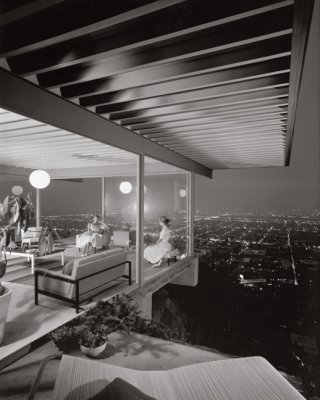
Banham's purpose in writing the book is to set out four ecologies that have led the way to Los Angeles' unique urban arrangement: the beach (Surfurbia, as he calls it), the freeways (Autopia), the flatlands (The Plains of Id), and the foothills (Foothills; I guess creativity runs out at some point for everyone). Based on these four ecologies, Banham celebrates what he sees as the best aspects of L.A.'s development: beach-front lifestyles; the personal freedom provided by automobiles; an architectural style which mixes Spanish Colonial Revival with the mid-century modern architecture brought there by pre-WWII German exiles; and the expansion of residential and other architecture into, over, and seemingly hanging from the nearby foothills. Banham's other main point is that the early railroads, rather than the later highways, in the area led to L.A.'s current multi-modal form (as opposed to the traditional mono-centric urban form. The highways, meanwhile, simply followed the tracks of the railroads. "If there has to be a mechanistic interpretation, then it must be that the automobile and the architecture alike are the products of the Pacific Electric Railroad as a way of life." (p. 220)


From a more personal standpoint, I was hoping to gain some familiarity with Los Angeles by reading this book. Imagine how disappointed I was when I finished the book and went back to the foreward to the 2009 edition and found that "neither Los Angeles nor Banham read now as they did in the 1970's, or even in the 1990's." Nonetheless, in order to see L.A. the way he did, Banham had to adopt an approach to urban analysis that was different from his peers of the time. Anthony Vidler described Banham as "challenging his field of inquiry" and "attempting, sepcifically in Los Angeles, to reinvent how architectural and urban inquiry might proceed anew." Where some see kitsch, Banham sees architecture in the vein of pop art. Where some see bogged-down traffic, he sees a freedom of mobility. Where others see dull cubes, he sees efficient and simply elegant architecture fitting its warm climate. For this reinvented approach--or even for having the courage to take such a different approach--Banham's book is worthy of study by planners and designers.
Tuesday, June 29, 2010
International Sports and Economic Development
Watching the World Cup recently, I started thinking about how much economic development within a country affects that country's performance in international sports competition. Having a lot of economic resources allows for more of those resources to be spent on athletics: coaches, training assistants, facilities, youth leagues, and especially player compensation. So athletic dominance can become more a display of economic success than of skill, determination, or individual initiative and practice. But there is still something to be said for passion and interest in a certain sport, particularly futbol (soccer) in many of the poor, war-ravaged, and otherwise disadvantaged countries.
Yet sports can actually play a role in economic development, helping poorer countries. An example of this, one could argue, is the World Cup being held in South Africa. Theoretically, all of the sales and economic stimulus that follows an event like the World Cup or the Olympics is supposed to boost the local and regional economy. But does it actually work?
Well, for one, there are aspects of the whole effort like this. Perhaps part of the idea was to spur the local economy, but bringing in Coca-Cola, McDonald's, and whoever made all of the official memorabilia will likely lessen the realization of that idea because a lot of the tourist dollars (or rand in this case) will be taken back when everyone packs up their things and goes home. Nonetheless, there's still all of the hotel rooms filled, cars and busses rented, and local food consumed by World Cup spectators, and other locally-oriented spending. So the effect exists, but it's not capitalized upon as much as it could be.
But is even that enough? An event like this is in a sense a one-shot injection of tourist activity. What about the places that consistently rely on tourist activity for their local economies? Las Vegas is an arguably successful and pretty familiar example for many young Americans. Mexico does pretty well, too, with attractions like Tijuana, Cancun, etc. But despite the enormous size of the tourism industry worldwide, it doesn't always work. Japan, for example, has had problems with their tourism industry. Besides the fact that it's not a guaranteed boost, tourism can fundamentally change, even destroy, the local character of a place. On the other hand, tourism can be used constructively, to aid the local economy and to preserve the local character, if it's done right. It's a careful balance.
Coming back to South Africa, if long-term tourism has such mixed results, how much benefit can be expected from a month of soccer or two weeks of Olympic competition? Estimates actually suggest that a lot can be expected. But the expected direct return can be quite less than the investment required to host an enormous international athletic event. Therefore, the hope is the indirect and long-term benefits: improved infrastructure as part of preparations for the event, positive international exposure, tourists who return because of their enjoyable first experience, etc.
Overall, it seems like there are a lot of possible pitfalls in relying on tourism, especially a single athletic event--as large and internationally important as it may be--but there is also a lot of potential to foster economic opportunities in former colonial countries whose infrastructure was long neglected, whose resources were taken without regard for their environments, and whose peoples were kept in poverty--even in slavery. And given that this year's World Cup is the first in Africa, the 2016 Olympics in Rio de Janeiro will be the first in South America, and that there has never been an Olympics in Africa, it seems that this opportunity is unfortunately, grossly underutilized. Sure, there may be reasons for this--fear of crime, the resources needed to put together a successful hosting application--but the fact that something is difficult is not a reason to avoid it and the potential benefits of an action make it worth doing.
Sunday, June 27, 2010
On Blogging
Having graduated more than a month ago--gosh, has it been that long already--I figured it was about time for me to start a blog. For my first post, I decided to write about blogging; a bit of metacommentary which I'm sure I'm not first wise guy to decide to do, but a nice introductory note nonetheless.
I'll begin with this video: http://www.youtube.com/watch?v=livzJTIWlmY. I'm excited to join this "micro-publishing platform" community, but am not sure how my efforts will turn out. Regardless, an important aspect of this blog for me, one that is unfortunately omitted from Seth Godin's laudatory endorsement of blogging, is the ability to stay in touch with numerous friends, simultaneously and at the convenience of each. It's not as personal as face-to-face conversation, sure, but when you're spread out across the country, busy with work or a degree or whatever else, face-to-face conversation isn't exactly an option. (There's always Skype, but I don't know if that actually qualifies as face-to-face.) Anyway, my friends will be able to check up on what I'm doing and thinking, and that's just another benefit I see in blogging, part of why I'm starting this.
As for the focus of this blog, my interest in urban planning will naturally dominate, but I'll feel free to discuss other things and you should feel free to read about them. Don't be surprised if Sherlock Holmes, the Beatles, or movies earn their own posts, (particularly if a movie comes out about Sherlock Holmes investigating an incident that happened to the Beatles, a sure sci-fi mystery thriller).
More importantly (for me, at least) than what I'll write about is the fact that I'll be writing something, something private and public at the same time. Perhaps I'm taking on this endeavor to open myself up--turn the flashlight at my thoughts, so to speak--for other people to see. After all, a good blog--if I may be so bold as to judge with any authority the quality of blogs--strikes a good balance between being private and public. It should reveal the inner thoughts of the writer and yet be accessible to a wide audience, friend, acquaintance, and stranger alike. Or not necessarily. As Godin says, a blog can be for everyone, for anyone, or for no one but the writer and the writer's cat.
So, as I embark on this journey known as a blog, and I invite you to watch me take it, I'll be searching for "the humility that comes from writing it." I'll try to keep with it regularly, but if I don't, then you can assume it's from lack of available time rather than of interest. We'll see where this takes me. Enjoy.
Subscribe to:
Comments (Atom)