Reyner Banham's writing has a wonderful flowing and entertaining style while maintaining an academic base. It therefore makes for a quick read, and an informative one. There are also many pictures, many of them taken by the author himself, of some of the more interesting architectural examples of the region.
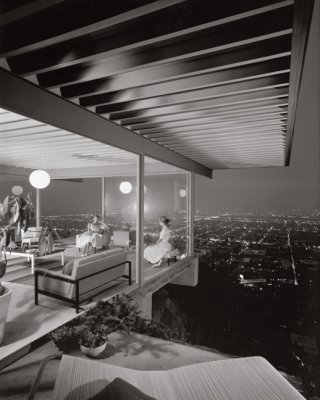
Banham's purpose in writing the book is to set out four ecologies that have led the way to Los Angeles' unique urban arrangement: the beach (Surfurbia, as he calls it), the freeways (Autopia), the flatlands (The Plains of Id), and the foothills (Foothills; I guess creativity runs out at some point for everyone). Based on these four ecologies, Banham celebrates what he sees as the best aspects of L.A.'s development: beach-front lifestyles; the personal freedom provided by automobiles; an architectural style which mixes Spanish Colonial Revival with the mid-century modern architecture brought there by pre-WWII German exiles; and the expansion of residential and other architecture into, over, and seemingly hanging from the nearby foothills. Banham's other main point is that the early railroads, rather than the later highways, in the area led to L.A.'s current multi-modal form (as opposed to the traditional mono-centric urban form. The highways, meanwhile, simply followed the tracks of the railroads. "If there has to be a mechanistic interpretation, then it must be that the automobile and the architecture alike are the products of the Pacific Electric Railroad as a way of life." (p. 220)
From a more personal standpoint, I was hoping to gain some familiarity with Los Angeles by reading this book. Imagine how disappointed I was when I finished the book and went back to the foreward to the 2009 edition and found that "neither Los Angeles nor Banham read now as they did in the 1970's, or even in the 1990's." Nonetheless, in order to see L.A. the way he did, Banham had to adopt an approach to urban analysis that was different from his peers of the time. Anthony Vidler described Banham as "challenging his field of inquiry" and "attempting, sepcifically in Los Angeles, to reinvent how architectural and urban inquiry might proceed anew." Where some see kitsch, Banham sees architecture in the vein of pop art. Where some see bogged-down traffic, he sees a freedom of mobility. Where others see dull cubes, he sees efficient and simply elegant architecture fitting its warm climate. For this reinvented approach--or even for having the courage to take such a different approach--Banham's book is worthy of study by planners and designers.



No comments:
Post a Comment